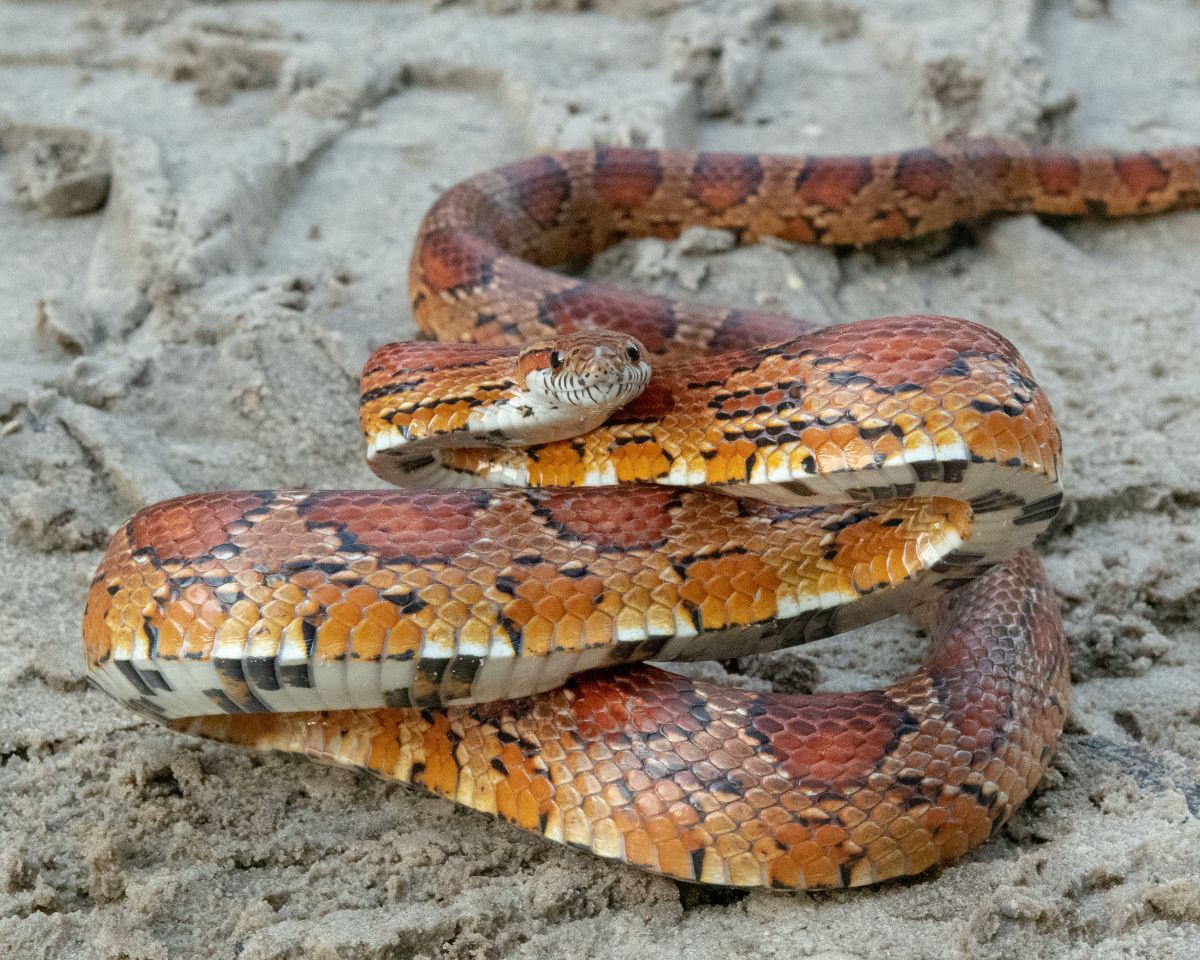
Red Cornsnake
Pantherophis guttatus · Rat Snakes
Tap a part to see what to look for. Tap it again to turn it off.
No venom, and it rarely bites even when picked up.
How to identify
- Head
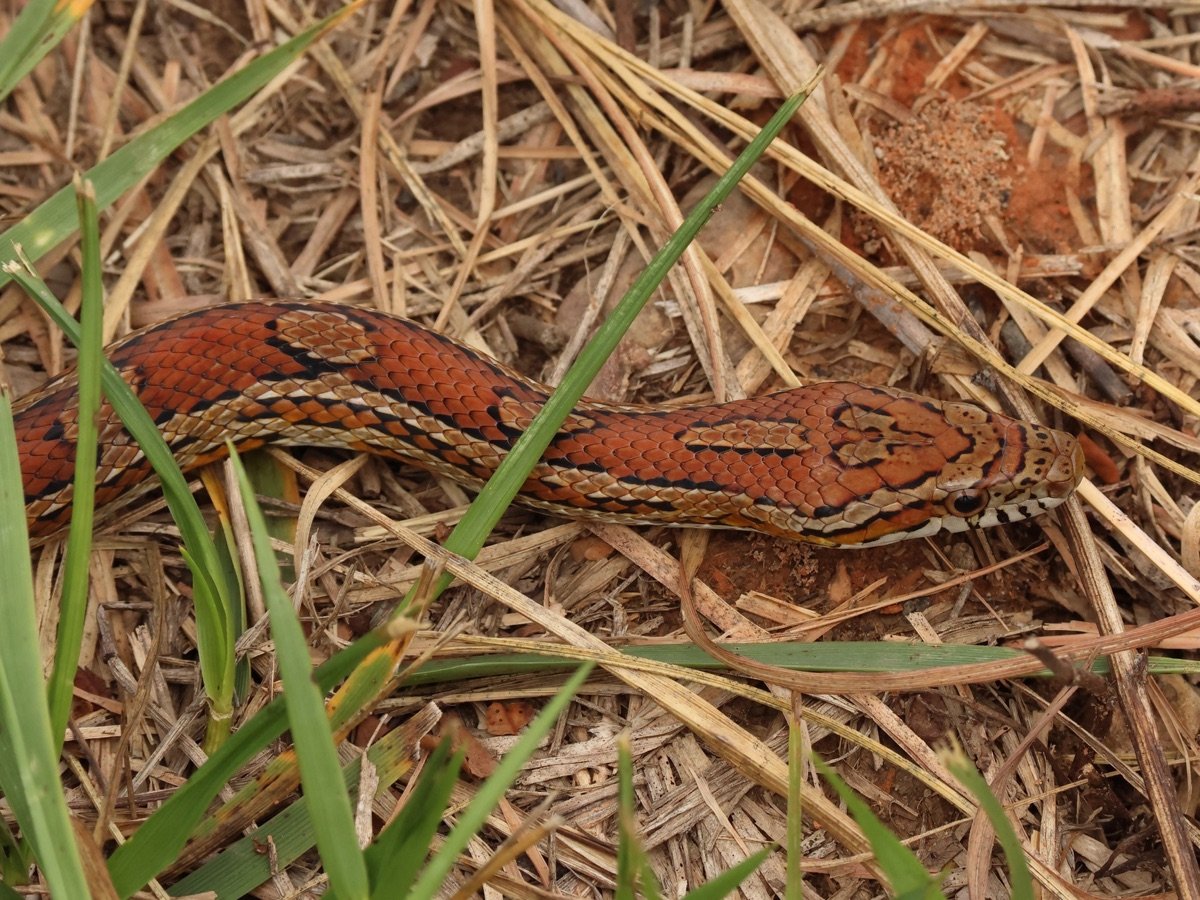
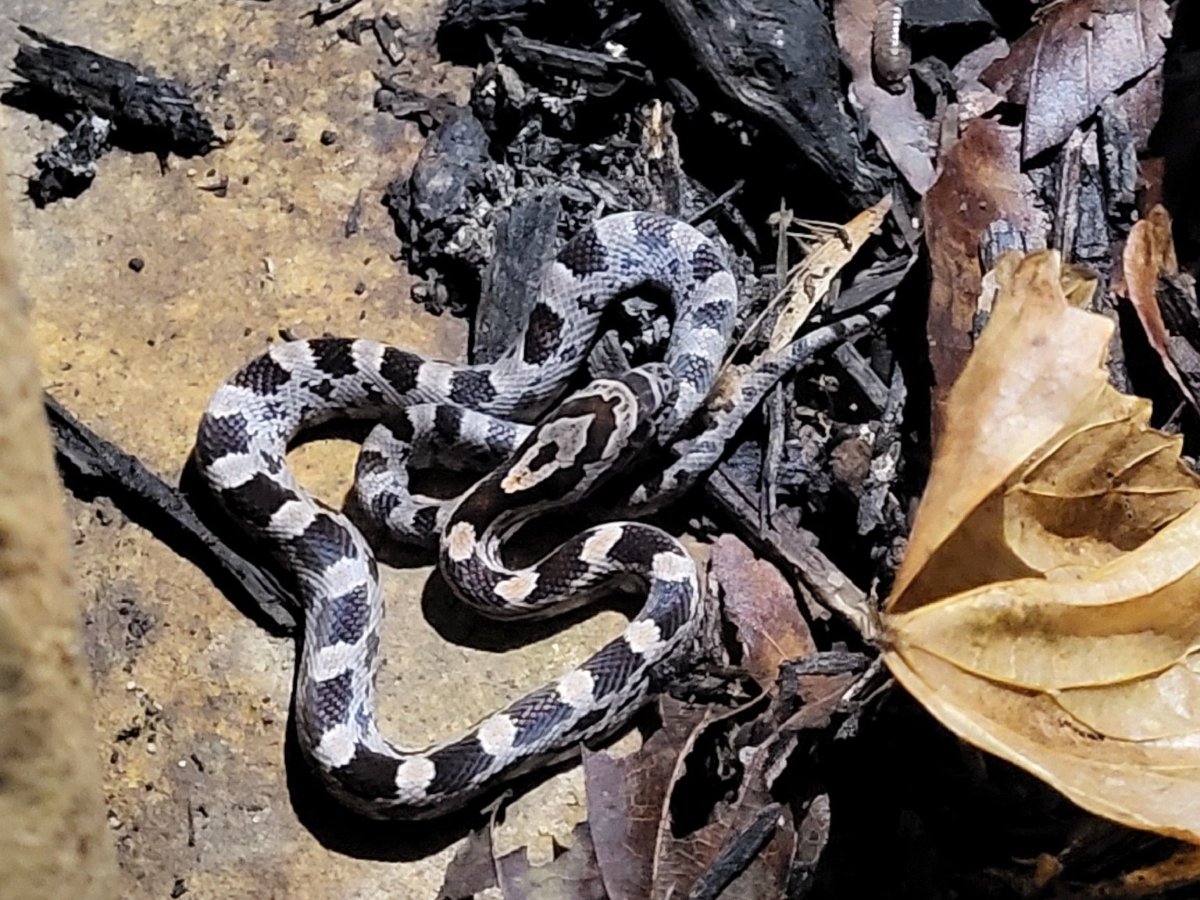
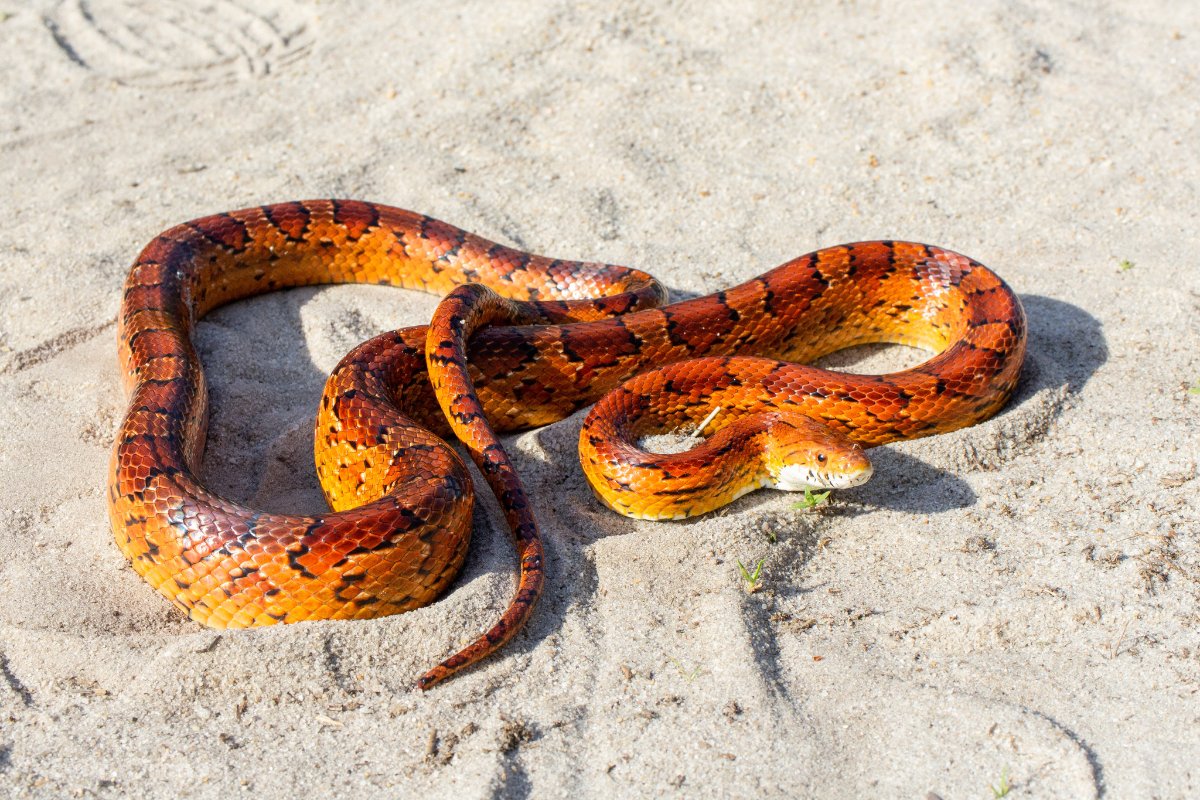
- Narrow head with a spear-point marking running forward between the eyes.
- Pattern
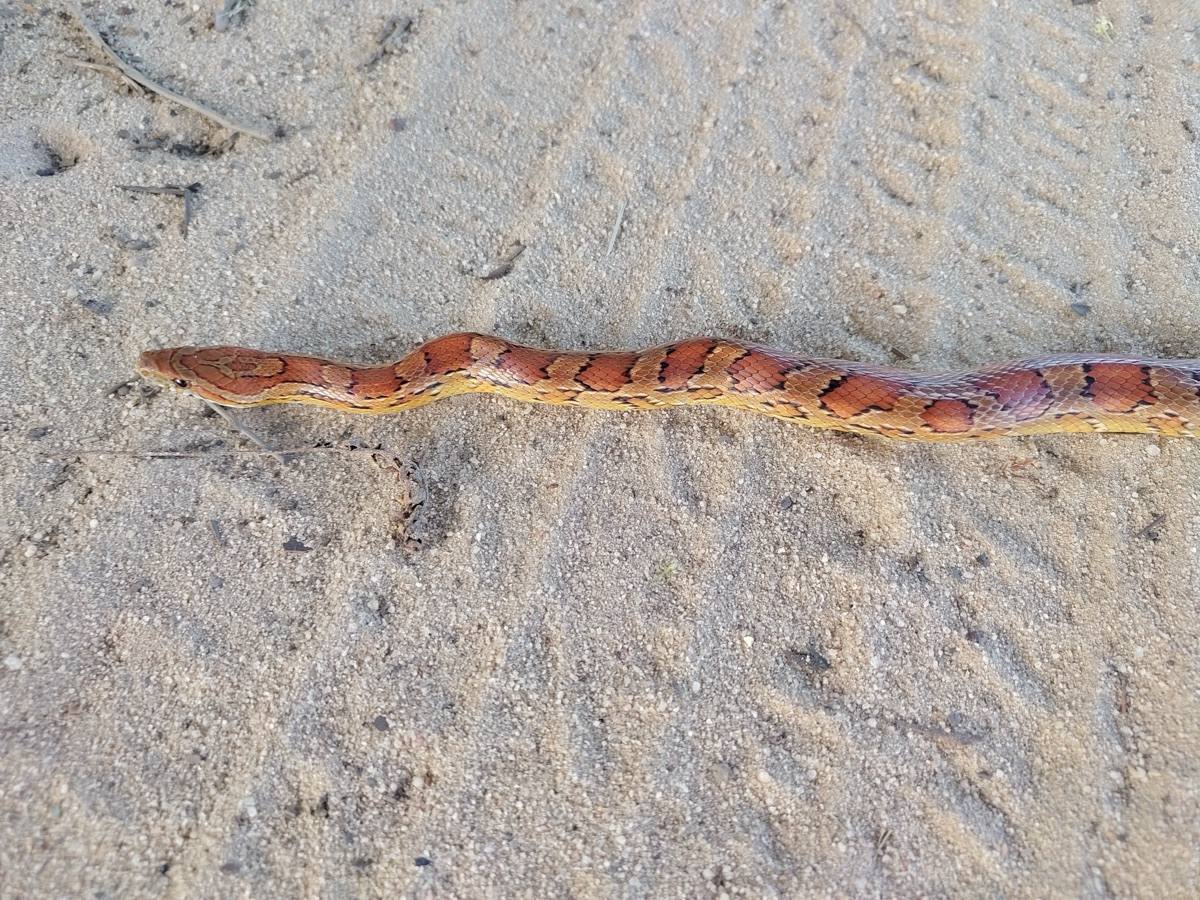
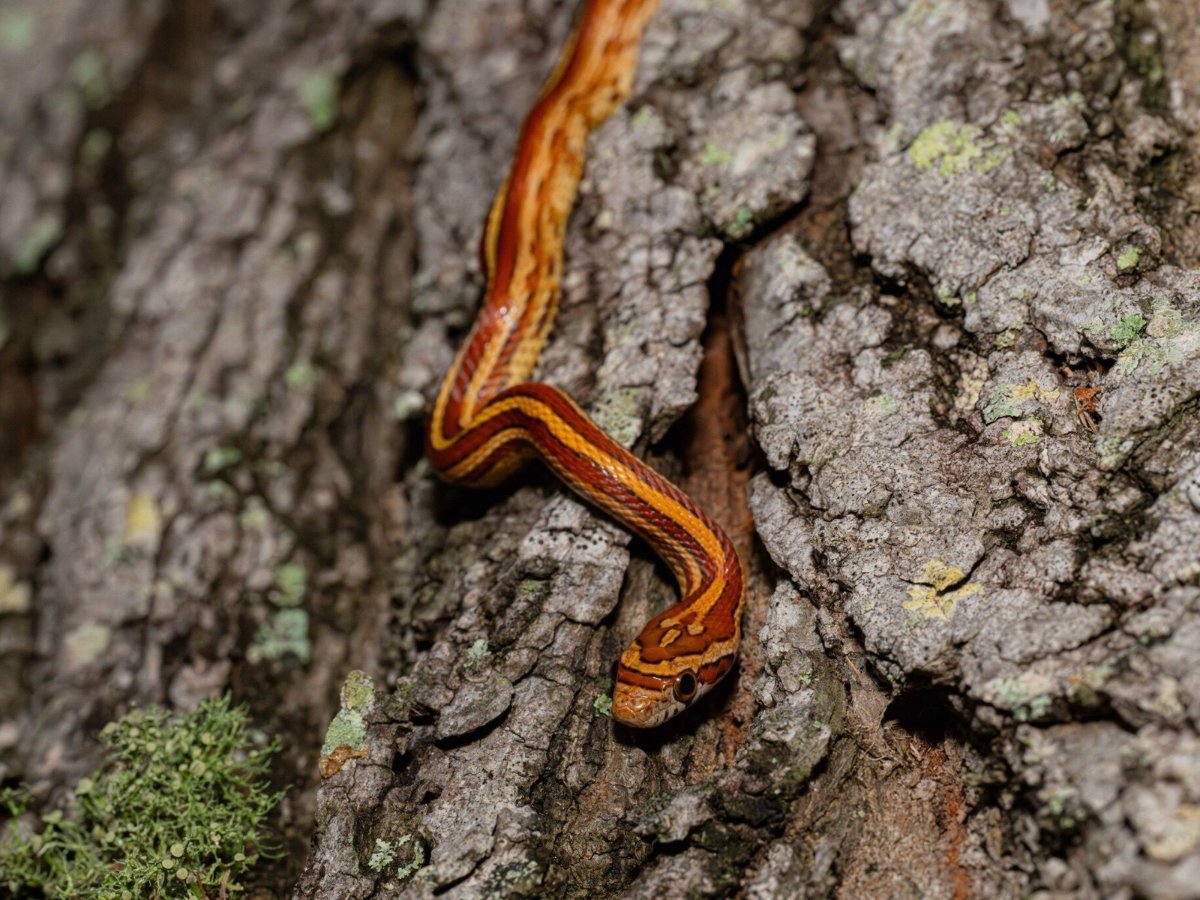
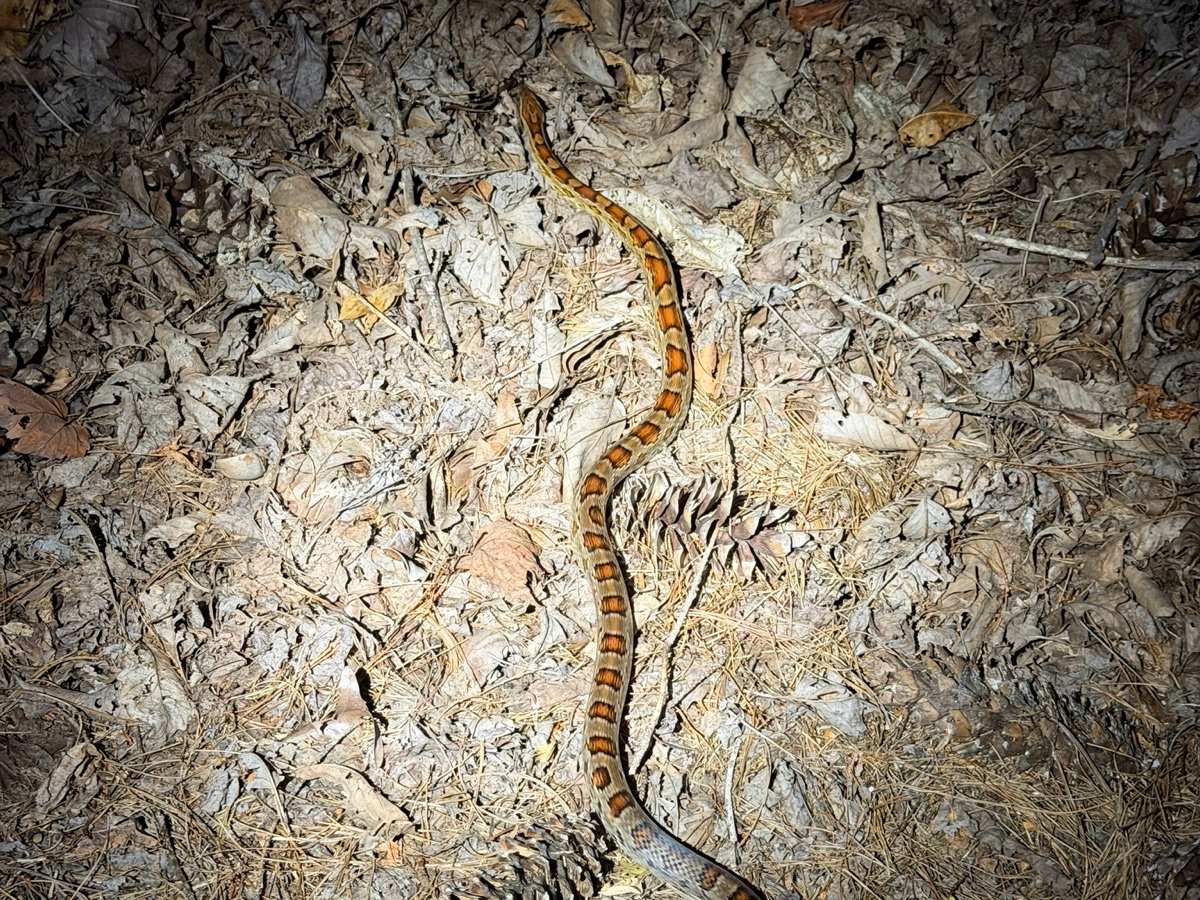
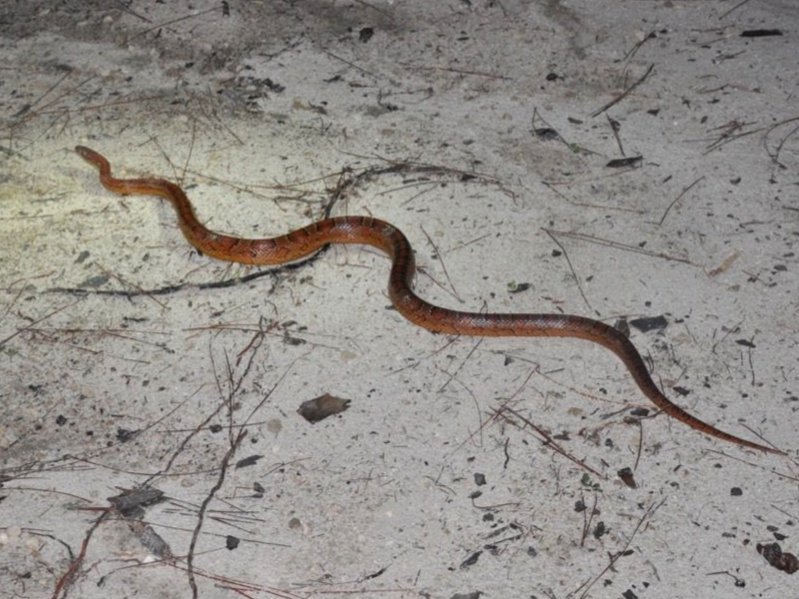
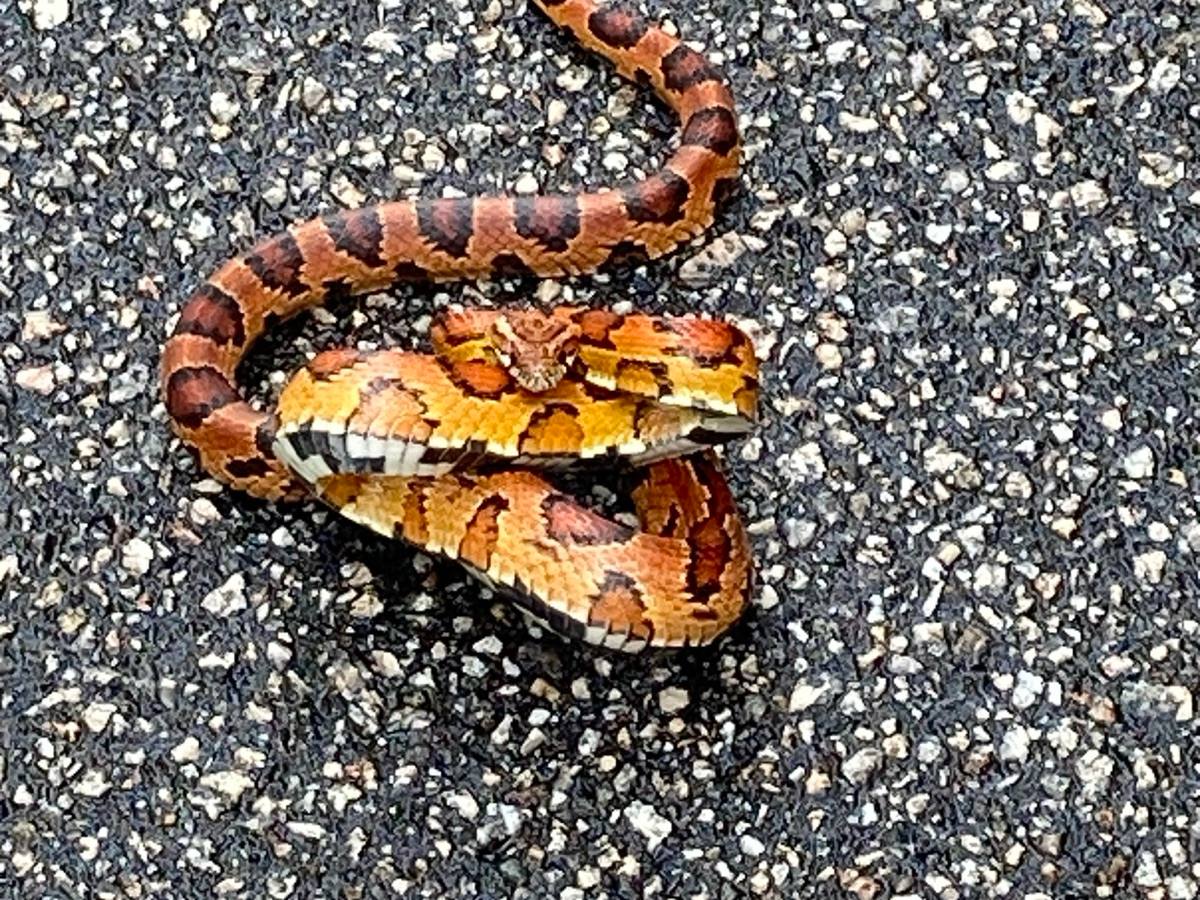
- Bold red-orange saddles edged in black on orange to gray; black-and-white checkerboard belly.
- Eyes
- Round pupil, orange-brown iris; no heat-sensing pit.
- Pits
- None. There is no pit between the eye and the nostril.
- Tail
- Tapers evenly, often striped underneath; no rattle.
- What it does
- Calm and slow to bite; freezes or slips into cover.
Often confused with
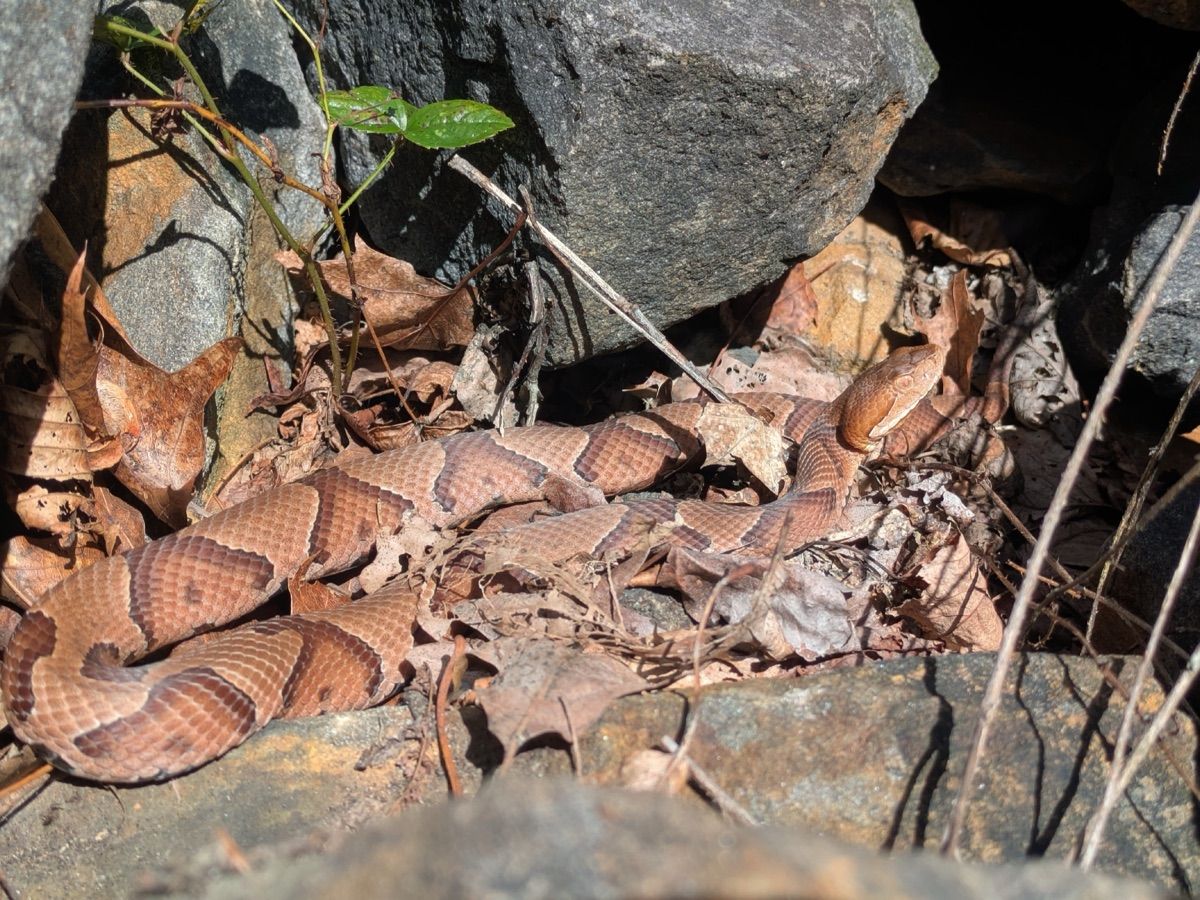
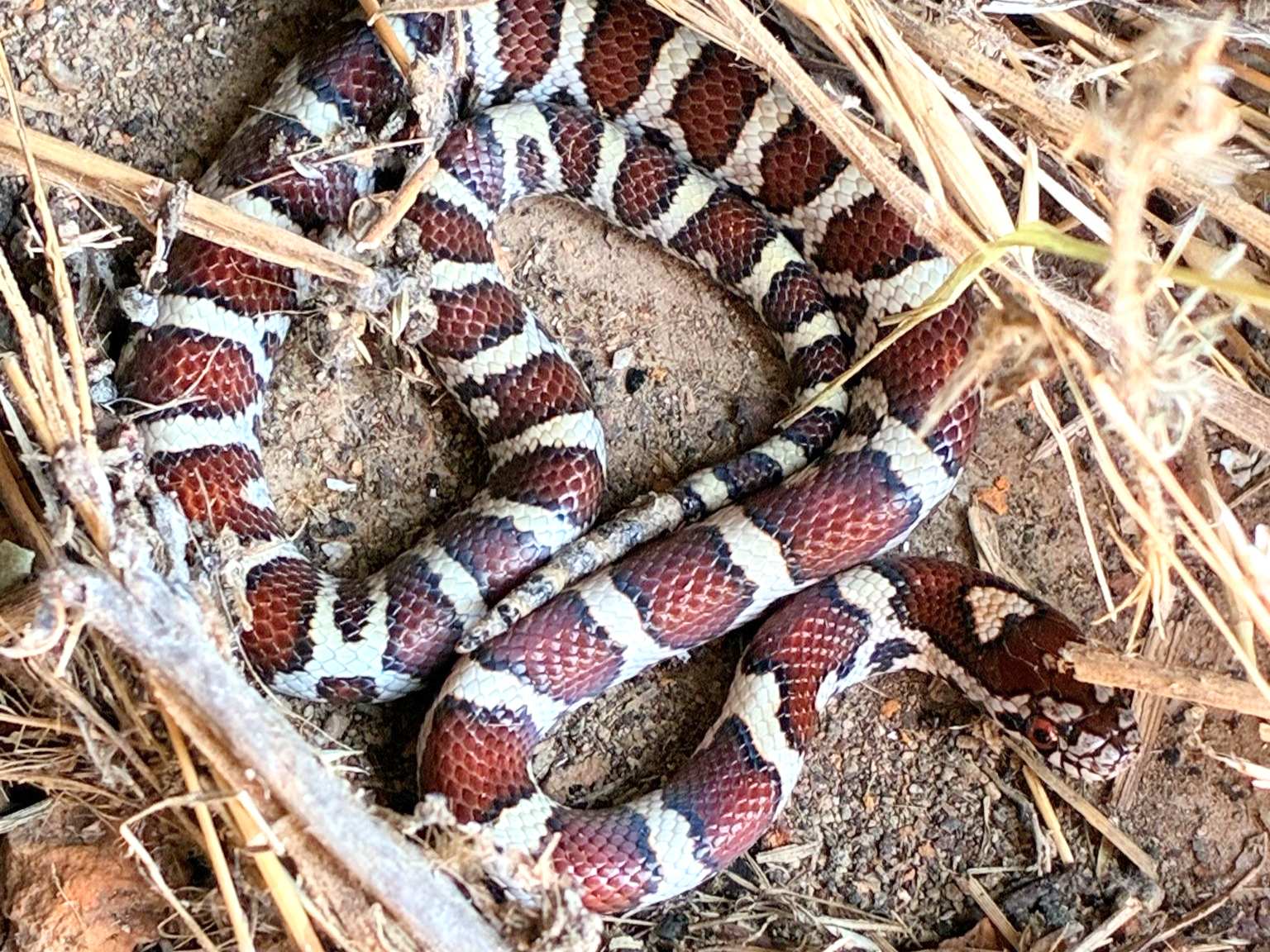
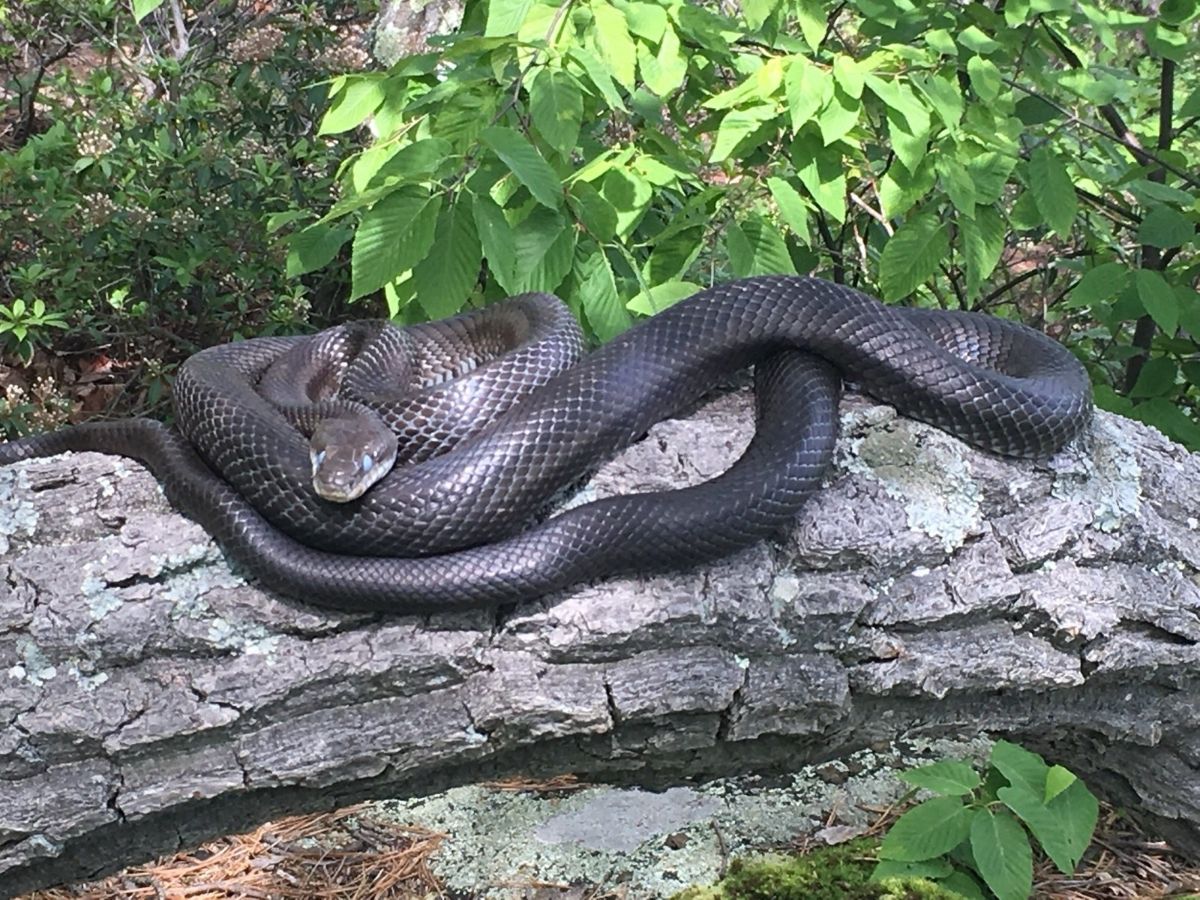
Eastern Copperhead is the usual mix-up: its bands pinch in at the spine and its head is plain copper with no spear mark. Young Eastern Ratsnakes are grayer with no spear mark or checkered belly, and Eastern Milksnake has black-edged blotches and a short cheek stripe.
How to tell them apart
Red Cornsnake vs Eastern Copperhead›
The quick way to tellLook at the top of the head. The cornsnake has a spear-shaped mark. The copperhead's head is plain copper with no markings.
Red Cornsnake: Narrow head with a spear-point marking running forward between the eyes.
Eastern Copperhead: Plain coppery triangular head with no stripes or blotches, clearly wider than the neck.
Red Cornsnake vs Eastern Milksnake›
The quick way to tellLook at the head markings. The Red Cornsnake has a spear-point mark that runs forward to meet between the eyes. The Eastern Milksnake has a pale Y or V patch on the back of the head instead.
Red Cornsnake: Narrow head with a spear-point marking running forward between the eyes.
Eastern Milksnake: Small head, often with a pale Y or V mark on the back of it.
Red Cornsnake vs Eastern Ratsnake›
The quick way to tellCheck the top of the head. The cornsnake has a dark spear-point mark pointing forward between the eyes. The Eastern Ratsnake lacks it. Adult Eastern Ratsnakes are also mostly black, or striped in Florida, not red-orange.
Red Cornsnake: Narrow head with a spear-point marking running forward between the eyes.
Eastern Ratsnake: Narrow head barely wider than the neck; white or cream chin and throat.
About the Red Cornsnake›
The familiar cornsnake of the Southeast, found in pine woods, old fields, farm buildings and barns — the name comes from the belly pattern and its habit of hunting rodents in corn cribs.
Gentle and slow to bite, it is one of the most widely kept pet snakes in the world, which is why so many color varieties exist in captivity.
The details
Size Usually 3–4 ft; occasionally 5 ftWeight About 1–2 lbLifespan 15–20 years wild, longer captive
Typical range›
Southeast: New Jersey south through Florida, west to Louisiana, Tennessee and Kentucky.
Activity›
Mostly active at dusk and night in warm months; hides by day under bark, boards and debris.
Diet›
Mice, rats, birds and eggs, killed by constriction.
Reproduction›
Lays eggs, usually 10–20, in early summer.
Found in parts of 14 states›
Ranges are approximate. It may be found in only part of a state, or be rare there, and snakes can turn up outside of them.
More photos